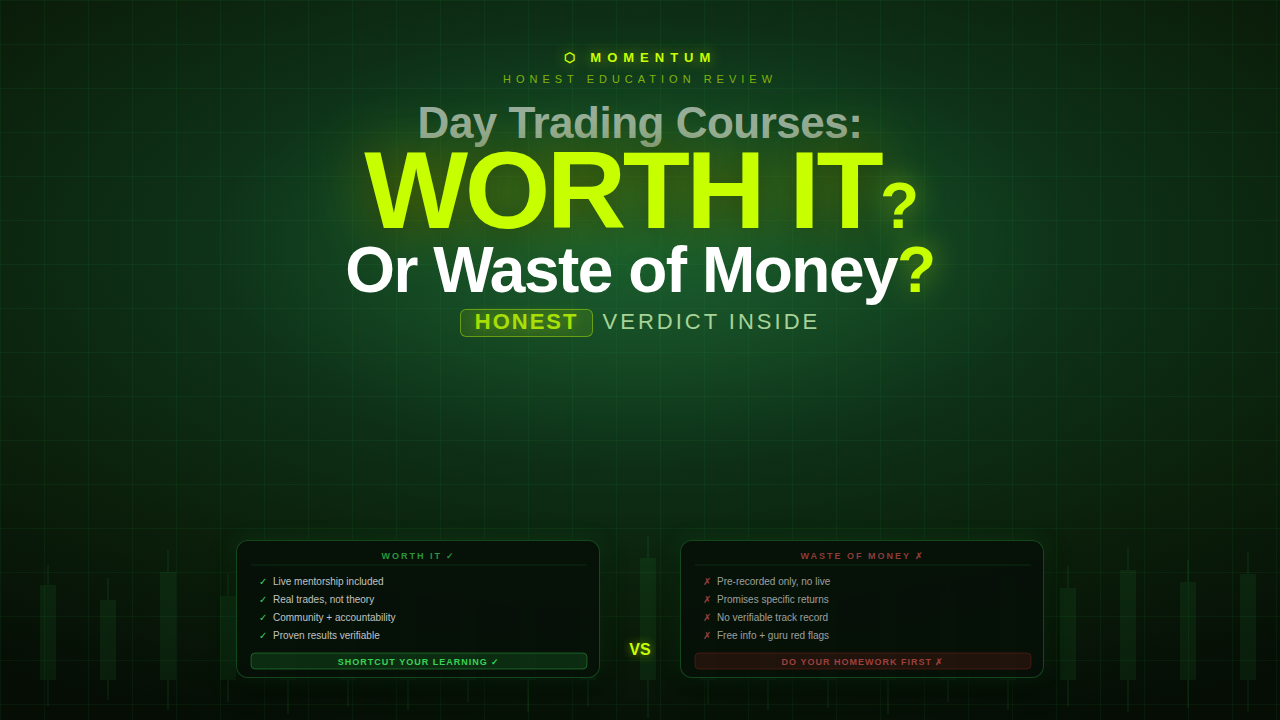
Day Trading Courses: Worth It or Waste of Money?
This guide will show you exactly how to tell the difference — and what to do if you want to learn without getting scammed.
.webp)
TL;DR
- Day trading courses are worth it if they give you structure, real execution examples, and accountability — and you actually do the reps.
- They’re a waste of money if they sell shortcuts, hide results, or teach you 50 indicators with no risk system.
- A course doesn’t make you profitable — a course can compress the learning curve by helping you avoid the most expensive mistakes.
- The best courses teach: risk management, a small set of setups, process/routine, and review/journaling.
- The biggest red flag is “income promises.” The biggest green flag is transparency + live market context.
- If you don’t have a plan to practice, journal, and review weekly, don’t buy anything yet.
People ask “Are day trading courses worth it?” because they’re trying to avoid two painful outcomes:
- wasting months learning random info
- wasting thousands on a flashy course that teaches nothing
Here’s the honest answer:
Some courses are absolutely worth it. Most are not.
This guide will show you exactly how to tell the difference — and what to do if you want to learn without getting scammed.
Why most traders buy courses (and why it usually backfires)
Most beginners don’t buy courses because they love learning.
They buy courses because:
- they want certainty
- they want a faster path
- they want someone to tell them “what to do”
That’s not wrong.
What’s wrong is buying a course that gives you information instead of a process.
Information doesn’t change outcomes.
Behavior does.
When a day trading course is worth it
A course is worth it if it does at least 3 of these:
1) Gives you a clear trading framework
You should walk away with:
- 1–2 setups you can explain in one sentence
- entry rules, exit rules, and invalidation
- position sizing guidelines
- a max daily loss rule
2) Shows real market execution
A course should show:
- live or replayed examples with full reasoning
- what to do when it doesn’t work
- how to avoid the “almost setup” traps
3) Builds routine (prep → execution → review)
You need a repeatable daily pipeline:
- scan
- shortlist
- levels
- scenarios
- trade window
- journal
- weekly review
Without routine, you won’t be consistent.
4) Teaches risk management like it’s the main skill
Because it is.
If a course spends 80% on entries and 20% on risk, it’s backwards.
5) Includes accountability or feedback
Self-paced courses are fine.
But feedback accelerates learning:
- community review
- Q&A
- trade reviews
- coach hot seats
When a day trading course is a waste of money (red flags)
If you see these, run.
Red flag 1: “Guaranteed income” or “$X per day” claims
Trading doesn’t pay salaries.
Any promise like that is marketing.
Red flag 2: No transparency
If they won’t show:
- real trade examples
- risk rules
- how they handle drawdowns
…you’re buying a story.
Red flag 3: Indicator soup
If the “strategy” requires:
- 8 indicators
- 12 alerts
- a custom script that only works in one market regime
…it’s usually a distraction.
Red flag 4: No process / no review system
If they don’t teach journaling and weekly review, the course won’t stick.
Red flag 5: Upsell ladder
If the “course” is just a funnel to:
- the real course
- the real mastermind
- the real signals
…expect disappointment.
How much should a good day trading course cost?
This depends on what it includes.
But here’s the clean framework:
Low-cost ($0–$500)
Usually:
- foundational education
- basic strategy overview
Good for: learning terminology and building a baseline.
Mid-tier ($500–$2,500)
Should include:
- structured curriculum
- real examples
- routines and risk management
- some form of community/Q&A
Good for: serious beginners and intermediate traders.
Premium ($2,500+)
Should include:
- live trading or frequent reviews
- direct feedback
- accountability
- a clear progression path
If it’s expensive and doesn’t include feedback, question the value.
The “worth it” test (5 questions to ask before buying)
Use this checklist before spending a dollar:
- Do they teach risk management as the main skill?
- Do they show real trades (wins AND losses) with reasoning?
- Do they have a simple playbook (1–2 setups) or a huge menu?
- Do they teach a daily routine and a weekly review?
- Is there accountability or feedback, or are you on your own?
If you can’t answer these clearly, don’t buy.
If you don’t buy a course, what’s the alternative?
You can absolutely learn without paying thousands.
But you still need structure.
A free/cheap learning plan:
- Pick one strategy lane (momentum day trading, for example)
- Trade one window consistently (usually the open)
- Build a watchlist process
- Sim trade with rules
- Journal every trade
- Weekly review and fix one leak
You can’t “wing it” and expect results.
You need a system.
Where TradeMomentum fits (and why it’s different)
Most “courses” are:
- theory
- recordings
- indicators
TradeMomentum is built around the part that actually changes behavior:
- live market execution (so you see decision-making in real time)
- nightly watchlists and prep structure
- rule-based risk discipline
- community accountability
That combination is why a program like TradeMomentum is often worth more than a static course.
Because it’s not just teaching you what a setup is.
It’s teaching you how to execute it under pressure.
Final word: courses are worth it when they buy you structure
A day trading course is worth it when it saves you from:
- expensive mistakes
- random learning
- inconsistent execution
But if you’re looking for a shortcut, the course won’t help.
The market only pays one thing:
repeatable execution.