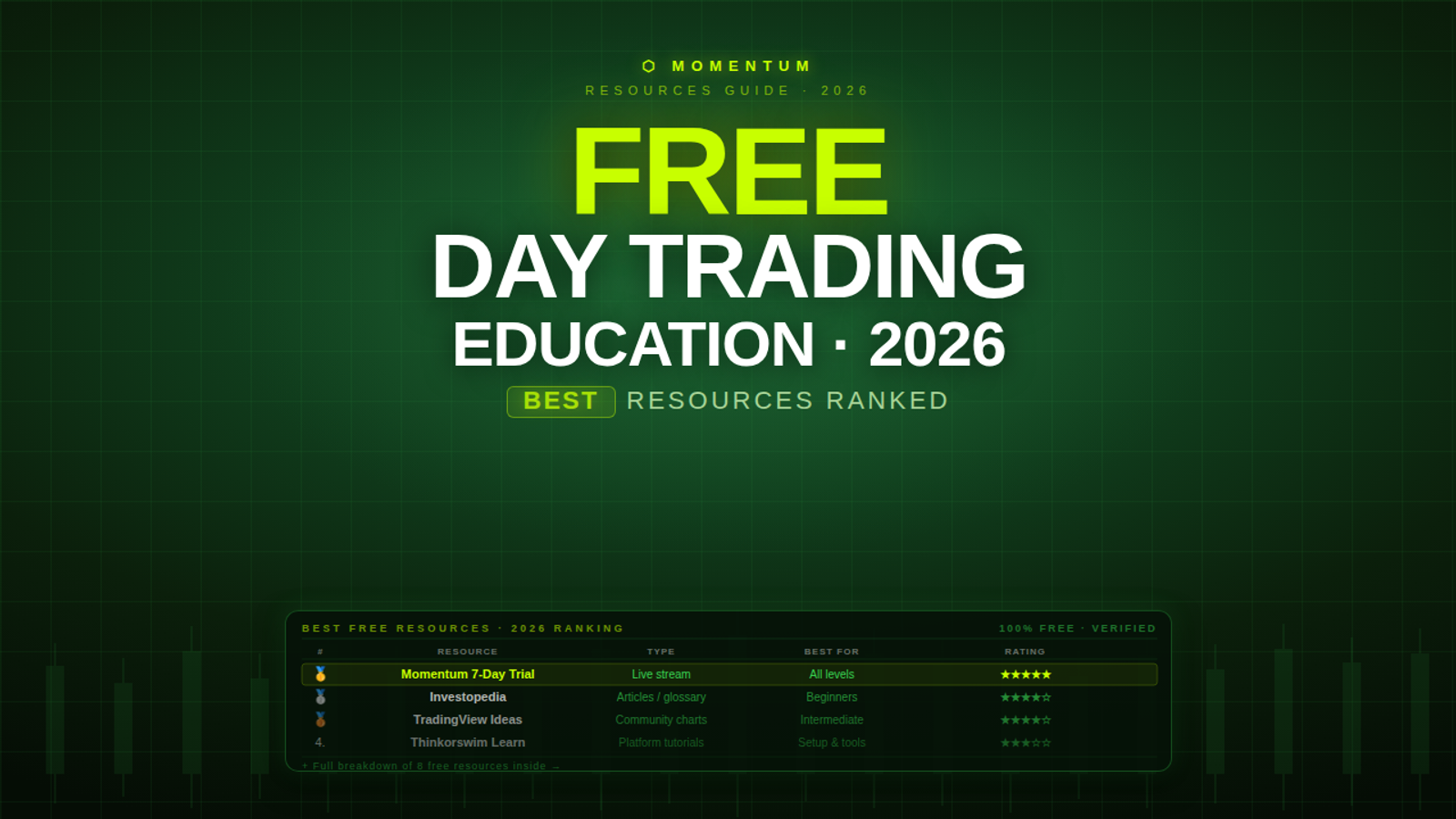
Short answer: Yes, you can build a real foundation for free. Start with the rules and the risks on Investor.gov, work through one free course such as the IBKR Traders' Academy, then practice on a paper trading account before you put in money. Free material rarely covers three things: a structured plan, a routine you practice every day, and a view of how a working trader decides. Watching that live is the paid step, and it is optional.
This page is a reading order. Every resource is named with what it teaches and what it asks of you, so you know before you click.
Where to learn, what each resource teaches and what it requires
What free education covers, and where it stops
Free education is good at vocabulary, fundamentals and worked examples. It is the right place to learn what a limit order is, how a stop works and what borrowing can do to an account.
It has one hidden cost: it is unstructured. That shows up as:
- strategy hopping
- inconsistent practice
- no feedback loop
- no tracking
The fix is a loop.
The 4-part free learning loop
- Learn one concept.
- Practice it in a simulator.
- Journal the outcomes.
- Review weekly and fix one leak.
If one of the four parts is missing, you are collecting information without building a skill. The rest of this page is a way to run the loop with free material.
Where to read the rules and the risks
Start here, before any strategy video. Investor.gov is the investor education site of the U.S. SEC. Its article on day trading carries a notice at the top: "This document is no longer being updated and may include information that is out-of-date." Use it for the risk, which does not go out of date. It says: "Day trading is not for the faint of heart as it involves minute to minute decision-making, as well as leveraged investment strategies that can lead to substantial losses." On borrowing it adds: "Leveraged investing can even result in losing more money, and in some cases substantially more, than initially invested."
The pattern day trader change
A new reader must know one 2026 rule change before going live: FINRA's new intraday margin requirements replaced the pattern day trader margin requirements, which applied to customers a brokerage firm designates as pattern day traders. Investor.gov states: "FINRA has adopted new intraday margin requirements that replace current day trading margin requirements." The new requirements took effect on June 4, 2026, and they "permit a transition period until October 20, 2027, for brokerage firms that need more time to comply."
In the site's words: "Your brokerage firm might continue operating under the old day trading margin requirements during the transition, or they might choose to migrate to the new intraday margin standards sooner." And: "You should contact your brokerage firm to be sure you understand how the changes might affect your account."
So ask your broker which rules apply to your account before you go live. The full story is in the PDT rule is gone: what it means for day traders.
Courses and reading worth your time
Pick one course and finish it. Two courses and one article are worth knowing.
IBKR Traders' Academy. Interactive Brokers states that "All Traders' Academy courses on IBKR Campus are available free of charge," and that the Academy "is designed for learners at all experience levels." Topics run from stocks and ETFs through technical analysis and trading technology. It does not currently issue digital certificates when you finish. Its beginner path lists a lesson titled IBKR Paper Trading Account.
Alison, Day Trading Strategies. Alison describes this as a free online course at beginner level, running about an hour and a half to three hours with video. Its learning outcomes include "Discuss money management in day trading" and "Explain how to set your trading capital and how much to risk on each trade". The page also offers a certificate through a separate button and an upsell to a paid plan. It states no certificate price, so check before you assume anything about the certificate.
Investopedia, Day Trading: The Basics. A readable starting article on what day trading is, how to start, which tools and strategies exist and what the risks are. It shows an update date of May 05, 2026, which is before the change above, so read its section on the old margin rule next to the Investor.gov glossary page. One of its tips is worth repeating: "remember that educational seminars and classes about day trading may not be objective."
Paid options are compared once, in best day trading courses, and are not ranked here. If you are brand new to all of it, day trading for beginners covers the basics in one place.
Free practice accounts, and what paper trading does not teach
Practice is where free education pays off, because it is the step where you make decisions. Three free options, plus a fourth to check:
- thinkorswim paperMoney. Schwab says: "Yes, thinkorswim paperMoney is free." It is "the virtual trading experience that lets you practice trading on thinkorswim using real-time market data." It needs a Schwab account to log in.
- Webull paperTrade. The page promises unlimited virtual funds and says "Orders are processed and filled against real-time data." You sign up to start.
- TradingView. The pricing page opens with a free plan that needs a sign-up. TradingView's support page says paper trading is "available globally for all users" and works without a deposit. You start it from the chart with the Trade button.
- IBKR paper trading. The Traders' Academy beginner path lists a lesson titled IBKR Paper Trading Account. Check what the account requires before you sign up.
Use rules for practice: the same trading window, the same setups, the same max loss, and a journal entry for every trade. Kev's version: "the first thing I tell every trader is to prove it on a simulator before you risk a dollar." His beginner guide adds: "Paper trade until your process is boring."
What a simulator hides
Our practice guide says it directly: "Most paper trading platforms give you perfect fills, instant execution, and zero slippage." Slippage is the gap between the price you expected and the price you got. It also warns that "Delayed data (even by 15 minutes) destroys your ability to learn timing." A clean practice record is a record of a simulator. It says nothing yet about fills (the price you actually get), nerves or size, so respect your max loss and daily stop in practice as if the money were real. See the safest way to practice day trading before going live.
What to learn for free, topic by topic
- Platform and order types. Market, limit, stop and bracket orders (a bracket order attaches a profit target and a stop to your entry), before your first trade. What is a stop-loss order carries the caveat that "A stop is a planning tool and carries no guarantee."
- Charting. Support and resistance, trend structure, consolidation versus trend, volume and VWAP, the volume weighted average price. Avoid piling on indicators: if you cannot explain your charting in one sentence, it is too complex.
- One or two setups. A breakout, or a pullback such as a breakout retest or a VWAP pullback.
- Scanning and watchlists. Catalysts such as news, gaps at the open and relative volume (today's volume compared with a normal day), then a watchlist of three to five names with levels and scenarios written down.
- Risk and sizing. Risk management is the whole job. Everything else is just finding the entry. Work out your risk per trade before you pick a stock, using the position size calculator.
- Psychology. Revenge trading, overtrading and moving your stop are behaviors, and reading about them only helps if it changes what you do. Losses are part of the game: keep them small, accept them and move on.
Watching a working trader decide
Reading and practice teach the rules. Seeing a person decide under pressure takes a live example. Kev's public YouTube channel, which the pricing page links to, has a 27-second clip of him reading a chart, labeled education.
The next step after the free material is the trial. The pricing page says: "Free for 7 days, then $197 a month. Cancel anytime." Cancel before day 7 ends and you are not charged. The checkout asks for your card. The trial holds the full membership: the live stream every morning, the Momentum Scanner, the Momentum Journal and every recording.
Kev trades small cap momentum stocks, long only, and calls out his entry and his stop as he takes each trade. He looks for at least 2:1 reward to risk, meaning a target at least twice as far away as his stop, and follows the 1-2-3 rule: risk no more than 1% of the account, never enter without 2:1, and stop for the day after 3 losses. In his words, "I trade from 9 to 11am, and then I stop."
A four-week plan with one resource and one journal entry a week
Week 1: Foundations
Read the Investor.gov risk article, start the Alison course for money management, and learn your platform's order types and stops. Check which margin rules your broker applies. Journal entry: one page with your max loss per trade and per day.
Week 2: One setup only
Take one technical analysis lesson from the IBKR Traders' Academy. Pick one: a breakout model or a pullback model. Practice it on thinkorswim paperMoney or TradingView. Journal entry: for every practice trade, the setup, entry, stop, exit and what you felt.
Week 3: Scanning and watchlist
Build a shortlist of three to five names each day. Mark your levels on a TradingView chart and write a scenario for each name. Journal entry: the shortlist, the levels and what happened to each name.
Week 4: Review and refinement
Review your journal like game tape. Find the mistake that repeats most and install one rule that fixes it. Journal entry: a weekly review with the top mistake and the new rule.
Four weeks gives you a routine, a journal and a view of your own habits. It will not predict how you do with real money.
How to spot a bad free resource
Treat a creator or channel as entertainment if they are:
- promising income
- selling strategies that never lose
- changing strategies every week
- focused on hype over process
Kev puts it in one line: "Anyone promising you a guaranteed daily income is selling hype."
When free is not enough
Free resources give you vocabulary, fundamentals and examples. What they rarely give you is structure around your own trading, a view of a working trader's decisions as they happen, and a place to ask questions while a setup develops. In the room, Kev talks through each setup as it develops: the entry, the stop and the risk, so you see the thought process behind every decision. The membership also includes a nightly watchlist at 5 PM and a pre-market watchlist at 9 AM.
Free day trading education: frequently asked questions
Can you learn day trading for free?
You can build the fundamentals without paying for a course: read the risks on Investor.gov, take lessons from the IBKR Traders' Academy and Alison, and practice on a paper trading account. Free material rarely gives you a structured plan or a view of how a working trader decides.
Is there a free day trading course?
Yes. Interactive Brokers states that all Traders' Academy courses on IBKR Campus are free of charge, and Alison describes its Day Trading Strategies course as free. Alison's page states no price for its certificate, so do not assume the certificate is free.
What should I open first?
The Investor.gov risk article. It covers what day trading is, borrowed money and the chance of losing more than you put in. Then pick one course and one paper account.
Is paper trading free, and what does it need?
Schwab says thinkorswim paperMoney is free and requires a Schwab account. Webull describes paperTrade as free, and you sign up to start. TradingView paper trading needs an account and does not need a deposit.
Do I still need a minimum balance to day trade?
Check with your broker. Investor.gov states that FINRA's new intraday margin requirements took effect on June 4, 2026, with a transition period until October 20, 2027, and that your broker might still operate under the old requirements during the transition. Our post on the pattern day trader change has the rest.
How long should I practice before trading live?
There is no set number of days. Kev's guidance is to paper trade until your process is boring: run the whole routine of watchlist, entry, stop, exit and journal, and respect your max loss and daily stop while you do.
Is YouTube enough?
Not on its own. Video is good for seeing examples, and it is easy to watch without building a routine. Pair any channel with the loop above: learn one concept, practice it, journal it and review it weekly.
Free for 7 days, then $197 a month. Cancel anytime. See the pricing page for what the membership includes, or the day trading chatroom page for how the live room works.
This content is for educational purposes only and is not financial advice. Trading involves significant risk and may not be suitable for all traders.