Failed Breakout Reversal Strategy (FBR): How Pros Trade Breakouts That Trap Everyone Else
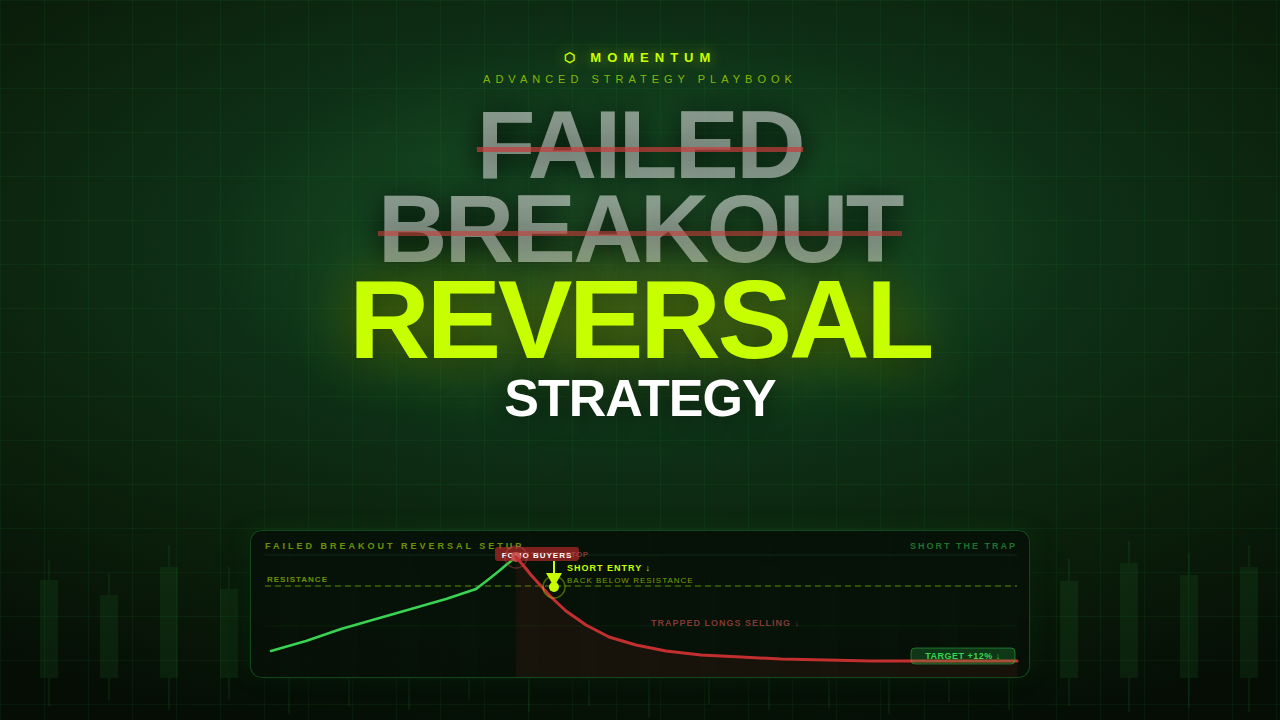
Once you learn to spot the trap, the failed breakout reversal (FBR) can become one of the most consistent day trading setups you’ll ever use.
.webp)
TL;DR
- A failed breakout reversal (FBR) is when price breaks a key level, can’t hold above it, then reclaims back below and dumps as breakout buyers get trapped.
- The best FBRs happen at obvious levels (PMH/PDH/whole dollars) with real volume and clear rejection (wicks, closes back below, no reclaim).
- Highest-probability entries are the reclaim short (break back below the level) or the retest short (reject the level from underneath).
- Keep stops simple: above the trap high (or above the retest high), and get paid into logical magnets like VWAP and the breakout base.
- Don’t force it: avoid fading strong trend days or “failed breakouts” off random, low-importance levels.
Most traders love breakouts for one reason:
They feel clean.
Price pushes through a level, you buy, it “should” keep going… and then it doesn’t. It snaps back under the breakout level, your stop gets tagged, and you watch it dump without you.
That’s not random.
A lot of “breakouts” are really liquidity grabs — price pokes above a key level to trigger breakout buys and stop orders, then reverses when there’s no real demand left.
The good news: once you learn to spot the trap, the failed breakout reversal (FBR) can become one of the most consistent day trading setups you’ll ever use.
This article breaks down:
- What a failed breakout reversal actually is
- The exact conditions you want before you trade it
- Entries, stops, profit targets, and common mistakes
- A simple checklist you can keep next to your screens
What is a Failed Breakout Reversal?
A failed breakout happens when price:
- Approaches a key resistance level (or premarket high / day high / major pivot)
- Breaks above it (or appears to)
- Can’t hold above
- Reclaims back below the level and starts dropping
That “breakout” was the bait.
The reversal is the trade.
Why it works (the psychology)
When price breaks resistance:
- Breakout traders buy the “confirmation”
- Shorts cover because they don’t want to fight strength
- Stops above the level get triggered (adding more buying)
Then, if there isn’t real follow-through demand:
- Those breakout buyers are now trapped
- Shorts re-enter (because they just got the best possible entry)
- Trapped buyers sell to escape
- The move accelerates down fast
That’s the edge: crowd positioning flips.
The 3 Types of Failed Breakouts (and which one you should focus on)
1) The “Pop-and-Drop” (best for momentum days)
- Breaks the level quickly
- Immediate rejection
- Fast flush
This is the cleanest version because you don’t sit through chop.
2) The “Grind Over / Fail Later” (harder)
- It breaks the level and holds for a bit
- Then it slowly rolls over
- Eventually loses the level and dumps
This one destroys impatient traders because it teases continuation.
3) The “Double Top Trap” (high probability when obvious)
- Breaks the level
- Rejects
- Tries again
- Fails again with weaker push
This is great when the level is super obvious and everyone is watching it.
If you’re newer: focus on #1 and #3 first.
The Market Conditions Where FBR Works Best
This setup isn’t magic. It’s a tool.
You want failed breakouts when the market is likely to produce traps.
Best conditions:
- Parabolic or extended move into resistance (late longs get desperate)
- Key level everyone sees (premarket high, whole dollar, previous day high)
- Weak market / weak sector (less support for continuation)
- Volume spike at the breakout but no follow-through (big clue)
- Liquidity time windows: open, mid-morning pushes, power hour
Worst conditions:
- Strong trend day with clean higher highs and higher lows
- News-driven continuation with real demand
- When the level is not meaningful (random lines = random outcomes)
The Failed Breakout Reversal Setup (Step-by-Step)
Here’s the structure you’re looking for.
Step 1: Identify a real level
Examples:
- Premarket high (PMH)
- Previous day high (PDH)
- Whole dollar / half dollar
- A major daily chart resistance
- VWAP extensions + key highs (advanced, but powerful)
If the level doesn’t matter, the trap doesn’t matter.
Step 2: Wait for the breakout attempt
You want price to push above the level and look bullish.
Breakout traders must believe it.
Step 3: Look for failure signals
You don’t short just because it “touched resistance.”
You short when it proves it can’t hold.
Good failure signals:
- Immediate rejection wick above the level
- Breakout candle closes back below the level
- Next candle can’t reclaim the level
- High volume but price isn’t advancing
- Tape/prints show aggression but no progress (advanced)
Step 4: Confirm the reclaim under the level
This is the trigger that changes the trade from “maybe” to “setup.”
The level becomes your line in the sand.
Entry Techniques (Pick One and Master It)
There are a few ways to enter. Don’t overcomplicate it.
Entry A: The “Reclaim Short” (simple + reliable)
- Wait for price to break above the level
- Then reclaim back below the level
- Short as it fails to regain it
Pros: clear invalidation
Cons: sometimes you miss the very top
Entry B: The “Retest Short” (best R:R)
- Price fails back under the level
- Then bounces up to retest the level from below
- Short the rejection at the level
Pros: best risk-to-reward
Cons: not every setup gives a clean retest
Entry C: The “Break of LOD / Micro Support” (momentum trigger)
- Price fails the breakout
- Then breaks a key intraday support (or LOD)
- Short the breakdown
Pros: aligns with momentum
Cons: can be late if the flush happens fast
If you’re building consistency: start with Entry A, then add Entry B.
Stop Loss Placement (Don’t Get Cute)
This is where most people mess it up.
Your stop should be where the trade idea is clearly wrong.
Most common stop options:
- Above the failed breakout high (the “trap high”)
- Above the level + a buffer (works if the move isn’t spiky)
- Above the retest high (if you used retest entry)
Rule: if price reclaims the level and holds above it with strength, you’re done. No debates.
Profit Targets (How Pros Get Paid)
Failed breakouts can flush hard — but only if you manage them correctly.
High-probability targets:
- Back to VWAP (common magnet)
- Back to the breakout base (prior consolidation range)
- Back to key intraday support (higher timeframe pivot)
- Partial + trail (best way to catch the “waterfall” dump)
A simple plan that works:
- Take partial profits into the first flush (so you don’t panic cover)
- Trail the rest using lower highs / VWAP / moving average (your method)
Example Trade Plan (Simple and Repeatable)
Here’s a clean “if/then” plan:
- If price breaks above PMH on big volume
- And it closes back below PMH within 1–3 candles
- Then I short the reclaim below PMH (or the retest)
- Stop above the trap high
- Target 1 = VWAP
- Target 2 = morning support / breakout base
- Runner = trail until it makes a higher high on the 1–2 min
That’s it. No fantasy targets. No praying.
The 6 Biggest Mistakes With Failed Breakout Reversals
1) Shorting too early
You saw a wick and smashed short.
That’s guessing, not trading.
Wait for the reclaim under the level.
2) Trading it against a strong trend day
On trend days, breakouts work.
Stop trying to be the hero fade trader.
3) Using tight stops on a spiky name
If the stock is whipping 30–50 cents per candle, your stop needs to respect that.
4) Ignoring volume
Low volume “breakouts” fail for different reasons — and they don’t always flush.
You want real participation so the unwind has fuel.
5) Not taking partials
If you don’t take something off into the flush, you’ll cover early or get shaken out.
6) Taking FBRs on random levels
A failed breakout of a meaningless level is just noise.
The FBR Checklist (Print This)
Before you short a failed breakout, check:
- [ ] Is the level obvious and important (PMH/PDH/whole dollar/daily)?
- [ ] Did price break above and invite breakout buyers?
- [ ] Did it fail back below the level (reclaim)?
- [ ] Is there clear rejection (wick/close back below/no reclaim)?
- [ ] Is volume present (participation)?
- [ ] Is the broader market/sector supportive (or at least not screaming trend day)?
- [ ] Do I have a defined stop (trap high) and a logical first target (VWAP/base)?
If you can’t answer those in real time, skip the trade.
Final Thought: This Setup Rewards Patience, Not Bravery
The failed breakout reversal isn’t about being “smart” or calling tops.
It’s about waiting for the market to show its hand:
Breakout attempt → failure → trapped traders → unwind.
Trade the unwind, not the ego.
That’s how you stop being the person funding someone else’s short entry… and start being the one taking it.