Power Hour Continuation Strategy (How Momentum Traders Trade the Last Hour Without Donating Profits)
When a stock trends cleanly all day (or sets up properly into the afternoon), the last hour often brings fresh liquidity and a final expansion move — especially if price is approaching key levels like HOD, whole dollars, or major daily resistance.
.webp)
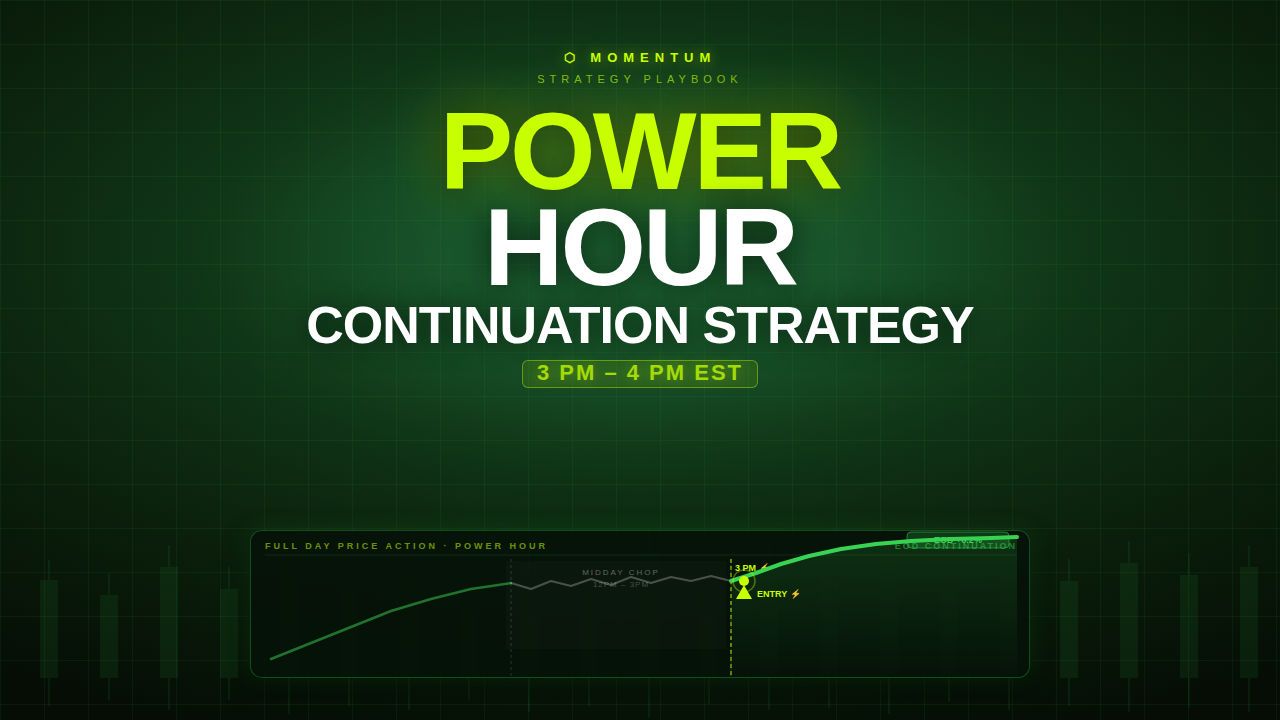
Most day traders treat the last hour like an afterthought.
Pros treat it like a second open.
The Power Hour Continuation strategy is built around one simple idea:
When a stock trends cleanly all day (or sets up properly into the afternoon), the last hour often brings fresh liquidity and a final expansion move — especially if price is approaching key levels like HOD, whole dollars, or major daily resistance.
But power hour is also where traders give back a full day of profits by forcing trades in chop.
So this article will give you a framework to trade power hour only when it’s worth it.
TL;DR
- Power hour (roughly 3:00–4:00pm ET) can produce a second momentum expansion as volume returns and breakouts trigger into the close.
- The best continuation setups come from stocks with clean all-day trend structure (higher lows / tight consolidations) and clear levels (HOD, whole dollars, key intraday pivots).
- High-probability entries are usually break + hold, break + retest, or tight flag breaks into the close — not random dips.
- Your “I’m wrong” level should be obvious (loss of the flag low / reclaim back into range / VWAP failure), and size should match afternoon liquidity.
- Avoid power hour when the stock is extended and exhausted, stuck in VWAP chop, or showing distribution (failed reclaims, weak bounces, heavy sell pressure).
What Is “Power Hour” (and Why It Matters)?
“Power hour” refers to the last hour of the trading day.
Common windows traders watch:
- 3:00–4:00pm ET (classic power hour)
- 3:30–4:00pm ET (the true “closing push”)
Why it matters:
- Institutions rebalance and execute late-day orders
- Traders position into the close (and into the next day)
- Breakouts through key levels get more participation
- Shorts often cover into the close, which can fuel squeezes
Power hour continuation isn’t about predicting. It’s about recognizing when a trend is still alive and ready for another leg.
The 3 Power Hour “Environments” (Know Which One You’re In)
1) Trend Continuation Day (best)
The stock has been trending with structure:
- higher highs + higher lows (for longs)
- clean pullbacks
- buyers defend levels
This is where power hour continuation shines.
2) Range/Chop Day (skip)
Price is chopping around VWAP, reclaiming and losing levels repeatedly.
Power hour here is usually just more chop with bigger candles.
3) Late-Day Reversal Day (different play)
The stock trends early, then rolls over, breaks structure, and power hour becomes a fade.
That’s not continuation. Different strategy.
Before you look for entries, identify the environment.
What “Continuation” Actually Looks Like Into the Close
A power hour continuation setup usually has compression + a clean trigger.
You want to see:
- A trend already established earlier in the session
- Price consolidating in a tight range (flag/base)
- Sellers unable to push it down meaningfully
- Breakout level that’s obvious and nearby
Continuation is not:
- “It’s green, so it should go higher”
- “It dipped, so it’s a good deal”
- “It broke HOD once, so I’ll keep buying every retest”
The Core Levels That Matter During Power Hour
Mark these before you trade:
- HOD (High of Day) and prior rejection points
- Whole/half dollars (especially on momentum names)
- Key intraday pivot highs/lows (afternoon bases)
- VWAP (important: is it support, or is price chopping through it?)
- Major daily chart levels (if you’re pushing into them late, expect reactions)
Power hour continuation is a levels strategy disguised as a “time of day” strategy.
The 4 Best Power Hour Continuation Setups
Setup #1: HOD Break + Hold (cleanest)
What you want:
- Price presses HOD multiple times (tight action under the level)
- Volume builds, wicks get smaller
- Then a clean break above HOD with follow-through
Entry options:
- Break + hold above HOD (conservative)
- Break + retest of HOD (best risk/reward)
Invalidation:
- Breaks out then reclaims back under HOD and can’t get back over
Setup #2: Tight Flag Break (afternoon coil)
This is the classic continuation pattern.
Structure:
- impulse move earlier
- tight sideways/downward flag
- volume contracts during the flag
- breakout resumes the trend
Entry:
- break of flag high
- or retest entry after break
Stop:
- below the flag low (or the last higher low inside the flag)
Setup #3: VWAP Hold + Reclaim (only if it’s clean)
VWAP can act like a “trend line” during strong days.
What you want:
- Pullback into VWAP
- Buyers hold it (or flush/reclaim)
- Then price curls back up into continuation
Warning:
If the stock has been slicing VWAP all afternoon, VWAP is not a signal — it’s noise.
Setup #4: Late-Day Breakout From an Afternoon Base
Some stocks do nothing midday, then build a base from ~1:00–3:00pm and break near 3:15–3:45.
What you want:
- multiple touches of resistance with higher lows underneath (pressure)
- base is tight (not wide and sloppy)
- breakout has clear room to next level
This is great when the stock has a catalyst and is attracting late attention.
Entries: The Only 3 That Matter
Pick one and stop improvising.
Entry A: Break + Hold
Wait for price to break the level and prove it can stay above.
Entry B: Break + Retest (best overall)
Let it break, pull back, then enter on the retest hold.
Entry C: First Pullback After the Break
If it breaks clean and pulls back into support, you enter the higher low.
What to avoid:
- entering mid-range
- entering on a red candle “because it’s cheaper”
- averaging down if it reclaims into the range
Risk Management (How to Not Give Back Your Day)
Power hour candles can be deceptively large, and spreads can widen.
1) Define your “line in the sand”
Examples:
- below flag low
- below HOD retest low
- reclaim back under breakout level
2) Assume reversals are faster late-day
The last hour can trap both sides quickly.
If the breakout fails, don’t negotiate.
3) Use partials
Continuation doesn’t mean it trends perfectly.
A simple plan:
- partial into first push after entry
- move stop to reduce risk once it proves
- runner only if structure remains intact
4) Don’t size like it’s 9:35am
Afternoon liquidity is different. Your sizing should respect that.
How to Spot a Power Hour Trade That’s About to Fail
Failure clues:
- Breakout with no follow-through (instant snap-back)
- Repeated failed reclaims of the same level
- Weak bounces (lower highs) after the break
- Heavy selling into strength (big wicks, inability to hold green)
- Stock pushing directly into major daily resistance with no pause
If the stock can’t hold the breakout level, it’s not continuation anymore.
The Most Common Power Hour Mistakes
- Forcing trades because “it’s power hour”
Time of day doesn’t create edge. Structure does.
- Buying the top of an extended move
If it already made the full move and is now spiking into resistance, you’re late.
- Trading chop around VWAP
That’s where consistency goes to die.
- No exit plan
If you don’t know where you’re scaling and where you’re wrong, power hour will punish you.
- Trying to turn a day trade into a swing trade by accident
The close is near. Decide ahead of time if you’re holding overnight (most traders shouldn’t).
Power Hour Continuation Checklist (Use It Live)
Before you enter:
- [ ] Is the stock trending cleanly today (not chop)?
- [ ] Is there a catalyst / real participation?
- [ ] Is there a tight flag/base with clear breakout level?
- [ ] Is volume contracting in consolidation and expanding on the break?
- [ ] Do I have a clear stop (flag low / retest low / reclaim level)?
- [ ] Do I have clear targets (next whole dollar / daily level / measured move)?
- [ ] Is this a continuation trade — or am I chasing exhaustion?
If you can’t check these boxes quickly, skip it.
Final Thought: Power Hour Is a Setup Window, Not a Guarantee
Power hour can be one of the most profitable parts of the day.
But only if you trade it like a professional:
- wait for compression
- trade clean breakouts with confirmation
- manage risk like the reversal can happen any second
Because it can.