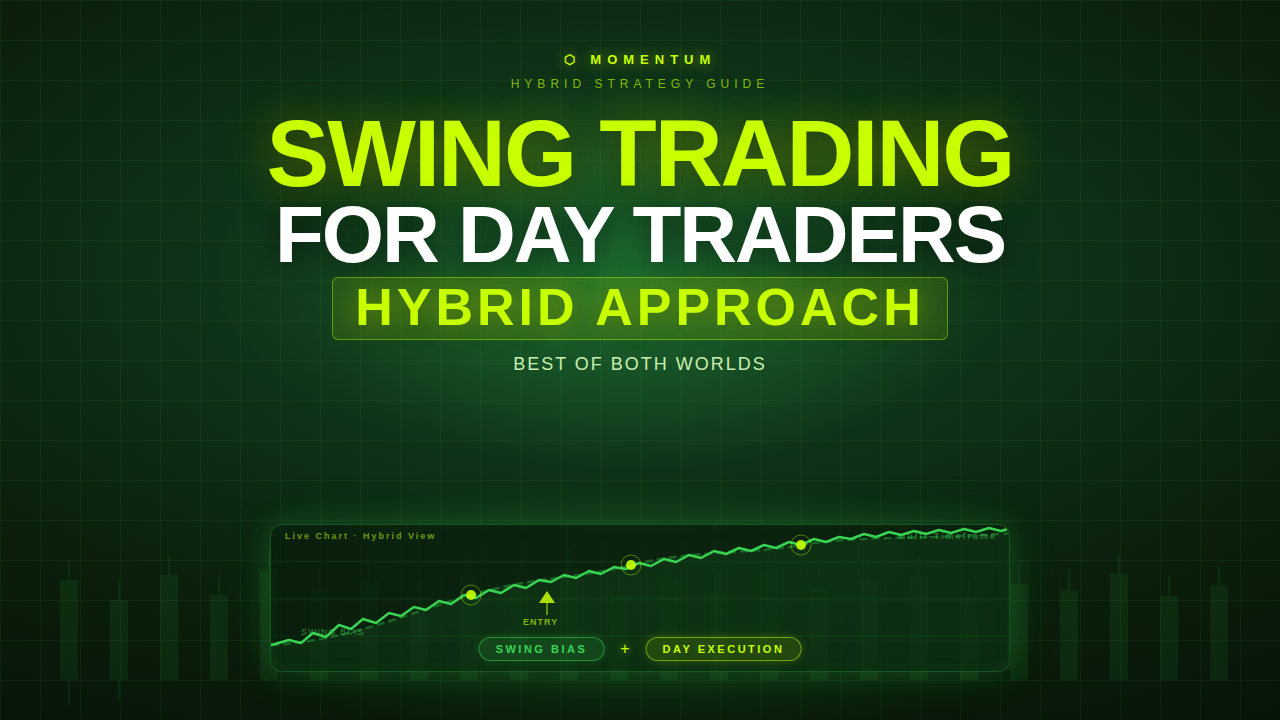
Swing Trading for Day Traders: Hybrid Approach Guide
This guide shows you how day traders can add swing trading without wrecking their discipline.
.webp)
TL;DR
- A hybrid approach works because day trading and swing trading solve different problems: day trading = focused execution; swing trading = capturing bigger moves without staring at screens.
- The #1 mistake is mixing timeframes emotionally (day trading a swing, swinging a day trade).
- Use a simple structure: day trade the open, swing trade the trend (different rules, different risk).
- Swing trades should be planned from higher timeframes (Daily/4H) and sized smaller because holding overnight adds gap risk.
- You can use swing trading to reduce overtrading: fewer decisions, more patience, more selectivity.
- If you’re part-time or have a job, hybrid is often the most realistic way to grow.
Most traders think they have to “pick a lane.”
Either:
- day trade every day, or
- swing trade and ignore intraday setups
That’s a false choice.
A smart hybrid approach lets you:
- day trade the highest-quality window (usually the open)
- swing trade the bigger, cleaner moves without needing to be glued to the screen
This guide shows you how day traders can add swing trading without wrecking their discipline.
Step 1: Understand the real difference (it’s not just holding time)
The biggest difference between day trading and swing trading is what you’re optimizing for.
Day trading optimizes for:
- precision entries/exits
- intraday volatility
- fast feedback
- tight risk
Swing trading optimizes for:
- capturing multi-day trend movement
- fewer decisions
- less screen time
- higher timeframe structure
Hybrid works when you respect those differences.
It fails when you blur them.
Step 2: The two hybrid rules that prevent chaos
If you only remember two rules, make them these:
Rule #1: Never day trade your swing thesis
If you’re in a swing trade and it dips intraday, you do not start clicking around on the 1-minute chart to “fix it.”
Your swing trade was planned on the Daily/4H.
Manage it on the Daily/4H.
Rule #2: Never swing trade your day trade mistake
If you day trade and you’re wrong, you don’t “hold and hope.”
That’s not hybrid.
That’s coping.
Hybrid traders still take clean stops.
Step 3: Who should use a hybrid approach?
Hybrid trading is a great fit if:
- you’re a day trader who overtrades when the market is slow
- you want more opportunity without more screen time
- you have a job / limited trading window
- you like day trading structure but want to capture bigger moves
It’s a bad fit if:
- you don’t have strict stop discipline
- you don’t journal or review (hybrid adds complexity)
- you chase trades emotionally
Step 4: The clean hybrid model (simple, repeatable)
Here’s the model that works for most traders:
Part A — Day trade the open window (execution)
- Window: 9:30–11:00 AM EST (typical)
- Goal: 1–3 A+ trades max
- Focus: momentum + key levels + clean setups
Part B — Swing trade the trend (positioning)
- Timeframe: Daily/4H for planning, 1H/4H for management
- Goal: 0–3 swing positions at a time (keep it tight)
- Focus: trend, levels, catalysts, clean structure
You separate:
- strategy
- timeframes
- risk
- expectations
That separation is what keeps hybrid from becoming a mess.
Step 5: How to build swing trades the “day trader” way
Day traders are good at execution.
Swing trading needs more planning.
A swing trade checklist:
- Trend: is the Daily trend aligned with your direction?
- Level: are you entering at/near a clean level (support/resistance)?
- Catalyst: is there a reason the stock can move (earnings, sector strength, rotation)?
- Risk: where is the invalidation (stop) and is it reasonable?
- Plan: what’s the target zone (next level, measured move, prior highs)?
If it’s not clear, it’s not a swing.
It’s a guess.
Step 6: Risk management (hybrid traders must be stricter)
Swing trades include overnight risk:
- gaps
- news
- earnings
- macro shocks
So you adjust:
- smaller size per trade
- wider stop (based on Daily structure)
- fewer positions
A simple guideline many hybrid traders use:
- Day trades: tighter stops, defined max daily loss
- Swing trades: smaller size, planned exits, no “surprise earnings holds”
If you’re new to sizing and risk, track in R and journal everything:
Trading Journal Template: Track Like a Professional.
Step 7: The hybrid weekly routine (how pros stay clean)
Hybrid traders win by routine.
Daily (10 minutes)
- update swing levels and alerts
- check if your swing thesis still holds
Weekly (60 minutes)
- review swing positions and screenshots
- grade execution
- identify mistakes (holding losers, early exits, adding risk)
- pick ONE fix for next week
This is how you keep both styles from bleeding into each other.
Common hybrid mistakes (and fixes)
Mistake 1: Too many positions
Fix: cap it. 1–3 swing positions max.
Mistake 2: Using the wrong timeframe
Fix: manage swing trades on higher timeframes.
Mistake 3: Overtrading because you “have swings anyway”
Fix: separate risk buckets and keep max daily loss.
Mistake 4: Holding day trade losers overnight
Fix: stop doing that. That’s not hybrid.
Final word: hybrid trading is about structure, not flexibility
Hybrid trading works when you add swing trading to reduce noise.
Not when you add swing trading to justify bad decisions.
Day trade the window.
Swing trade the trend.
Journal everything.
Review weekly.
That’s the hybrid approach that actually scales.