Short answer: A margin call is your broker's demand for more cash or securities, or for you to sell positions, when account equity falls below its maintenance requirement. FINRA's minimum is 25%, and its June 4, 2026 rules apply it all day. Brokers have until October 20, 2027 to comply, and many set higher rates.
What is a margin call?
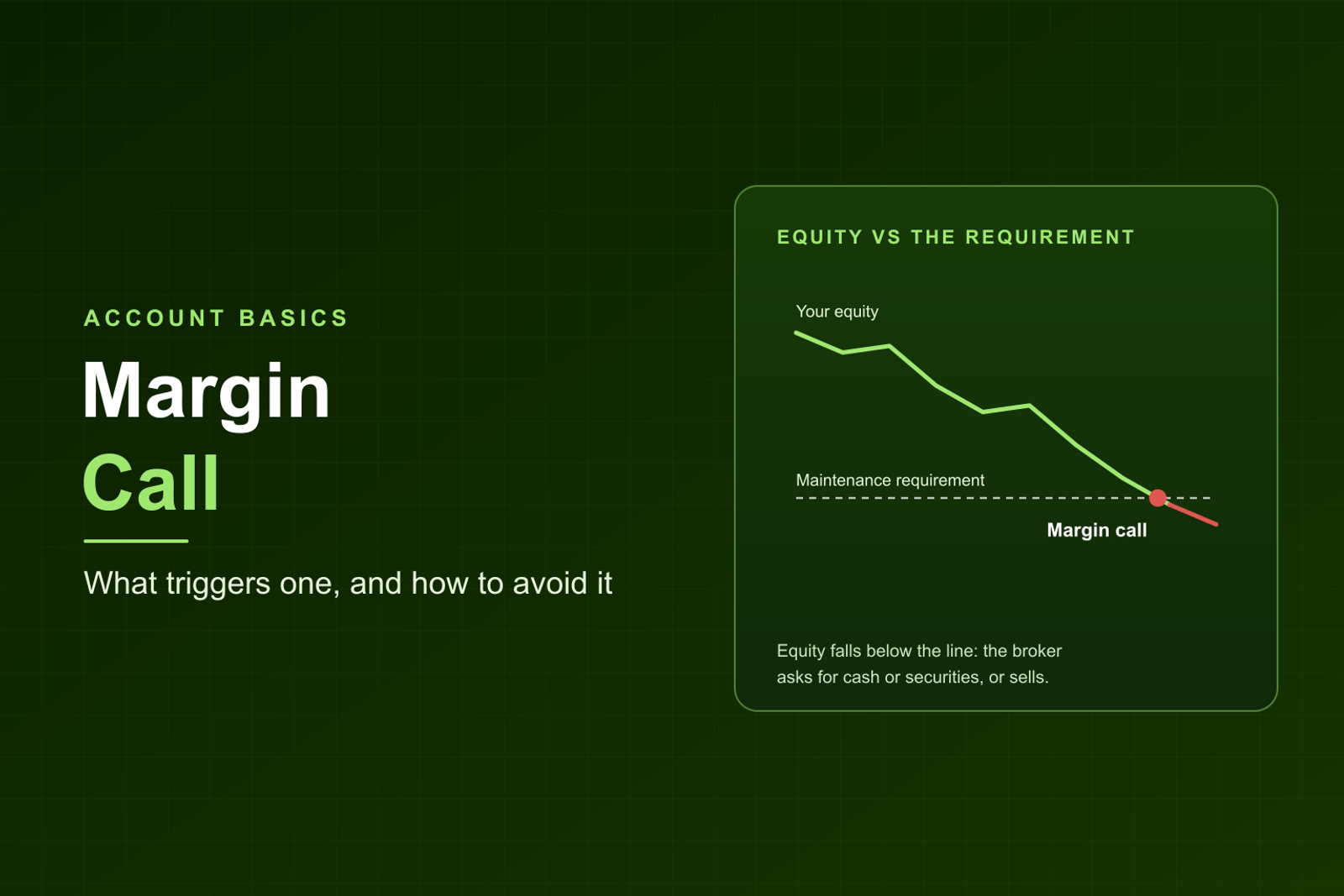
A margin call is your broker asking you to restore equity in the account. The SEC's Office of Investor Education and Advocacy says in its investor bulletin on margin accounts "your firm generally will make a margin call to ask you to deposit more cash or securities into your account". Investor.gov's glossary entry adds that the firm can "sell any of the securities in your account to cover any shortfall, without informing you in advance."
Equity is the value of your securities minus what you owe your broker. The maintenance requirement is the minimum equity you must keep, as a share of your positions' market value, and a house call comes from a broker's own, higher rate. The table lists the four types of call.
Source: the Investor.gov (SEC) bulletin of June 10, 2021, eCFR 12 CFR 220.12, the Merrill Edge margin calls page, the Schwab page of November 2, 2026 and the FINRA explainer of April 20, 2026. All read on November 25, 2026.
What triggers a margin call
A call comes when equity falls below maintenance or a new position lacks initial margin. Regulation T sets the initial margin on a margin equity security at "50 percent of the current market value of the security or the percentage set by the regulatory authority where the trade occurs, whichever is greater" (eCFR, 12 CFR 220.12, version dated November 20, 2026). The SEC puts it as "you may borrow up to 50 percent of the purchase price of margin securities".
Next is maintenance. The SEC bulletin says FINRA rules require maintenance "to be at least 25 percent of the total market value of the margin securities", and that firms often set it "typically between 30 to 40". Fidelity agrees: "most brokerage firms have stricter requirements that demand you maintain at least 30% equity".
Then the minimum. FINRA's April 20, 2026 explainer, as syndicated by FINRA, says "$2,000 is the minimum equity required to engage in leveraged trading".
A price drop is one trigger, and a rate change is another. Investor.gov says "A brokerage firm may at any time change the threshold at which customers are subject to a margin call."
A margin call example
Start with the SEC's own numbers. Its bulletin describes a buyer who will "purchase $16,000 worth of securities by borrowing $8,000 from your firm". If the market value falls to $12,000, equity is $4,000. At 25 percent, "you must have $3,000 in equity in your account (25 percent of $12,000 = $3,000)", so there is no call. "But if your firm has a maintenance requirement of 40 percent, you would not have enough equity." The firm "would require you to have $4,800 in equity (40 percent of $12,000 = $4,800)", and "the equity in your account has fallen $800 below" that line. Same price, different rate.
Now a smaller computed example, using the formula in plain words: equity is market value minus the loan, a call comes when equity drops below the maintenance rate times market value, and the trigger value is the loan divided by 1 minus the rate. Say $5,000 of your own money plus a $5,000 loan buys $10,000 of stock.
- At 25% maintenance, the call comes when the position falls below $6,667 (computed: 5,000 / 0.75), a fall of 33.3%.
- At a 30% house rate, it comes below $7,142.86 (computed: 5,000 / 0.70), a fall of 28.6%.
Both agree with our cash account vs margin account page. A higher rate leaves less room.
What happens if you ignore a margin call
The SEC bulletin says "If you are unable to meet the margin call, your firm will sell your securities to increase the equity in your account", and "your broker may be able to sell your securities at any time". The glossary adds: "The brokerage firm decides which of your securities to sell."
You also do not get extra time. The SEC bulletin says "You are not entitled to an extension of time on a margin call.", and Schwab's own page repeats it.
The SEC says "You can lose more money than you have invested", and in its $50 stock example the buyer would "also owe your broker an additional $10 plus the interest on the margin loan".
How margin calls work for day traders after June 2026
FINRA's new intraday margin framework took effect June 4, 2026. Its April 20, 2026 explainer says "There's no $25,000 minimum equity requirement for day trading." What remains is the maintenance requirement, which must hold "throughout the entire trading day." "Your firm has the authority to impose higher requirements if they choose."
If your equity cannot cover your open positions, you have an "intraday margin deficit" that you are "expected to satisfy as promptly as possible". FINRA warns: "If you repeatedly fail to satisfy intraday margin deficits promptly, this may result in your account being restricted for up to 90 days." Firms "may choose to monitor margin accounts in real time and proactively block trades that would create deficits". The rule change keeps margin calls for day traders and moves the check into the day. See what the PDT rule change means and day trading under $25K.
Brokers have until October 20, 2027 to comply. Investor.gov says "your brokerage firm might continue operating under the old day trading margin requirements during the transition", so check which rule your broker runs.
Source: each broker's own page, read on November 25, 2026. Each deadline is that broker's own rule.
Why low-priced and volatile stocks can trigger calls sooner
Low-priced stocks can carry higher requirements, and brokers can raise them on volatile names. Merrill Edge's table, for long positions, lists a maintenance requirement of 30% of market value above $10.00 per share, $3.00 per share between $3.01 and $10.00, and 100% of long market value under $3.00. It can raise house requirements "at any time including on specific securities experiencing significant volatility". Those are Merrill Edge's own rules.
Schwab's page on a first margin call (dated May 22, 2026) says the size of the margin requirement "varies by security". It adds "Some securities, such as penny stocks or IPO shares, are considered nonmarginable", meaning the broker will not lend against them.
For a trader of small, fast stocks, the line can move on the exact names you trade.
How to avoid a margin call
Five steps reduce the risk of a call, and none guarantees you avoid one.
- Size from your stop. I trade from a margin account myself. On how to avoid blowing up your first trading account I say: "My ceiling for a single trade is 1% of the account." And "My size comes from my stop."
- Do the stop math. A pre-planned stop with 1% sizing is meant to keep a position far from the call line. A hypothetical, computed example: on a $10,000 account, a 1% limit is $100. A $0.20 stop on a $5.00 entry gives 500 shares (computed: 100 / 0.20), a $2,500 position that loses $100 at the stop, 1% of the account. Our position size calculator runs the same math. A gap can move past a stop, so stops and size lower the risk without ending it.
- Leave a cushion. Fidelity's tip is "Leave a considerable cash cushion in your account that protects you from a sudden drop in the value of your loan collateral."
- Know your broker's rate and clock. Read the margin agreement for the house requirement, the deadline and whether it runs the old or new day trading rules.
- Monitor your account. Its other tip is "Monitor your account daily".
A stop-loss order supports the first two.
How to meet a margin call
Fidelity lists three ways, using a $2,000 call and a 30% maintenance requirement.
- Deposit cash. "You could simply deposit $2,000 into your account."
- Deposit marginable securities. These are securities your broker will lend against. You "divide $2,000 by 0.70 to arrive at the figure of $2,857", so $2,857 of stock covers it.
- Sell stock. "You would sell $6,670 worth of stock to satisfy your $2,000 margin call."
Selling takes more because each dollar sold frees only part of the requirement (computed: $2,000 / 0.30 is about $6,667).
Frequently asked questions
What is a margin call in simple terms?
A margin call is your broker's demand that you add cash or marginable securities, or sell positions, because your account equity has dropped below its maintenance requirement. FINRA's minimum is 25%, and many brokers set 30% or more. If you do not act, the broker can sell for you.
What triggers a margin call?
Equity falling below the maintenance requirement is the usual trigger, and a broker raising its own rate can do it too. FINRA's minimum is 25%, and Investor.gov says a firm "may at any time change the threshold". At brokers on FINRA's new rules, effective June 4, 2026, the requirement is checked throughout the trading day.
Can a margin call make you owe money?
Yes. The SEC says "you can lose more money than you have invested". If your broker sells your securities and the proceeds fall short of the loan, you can owe the difference plus interest on the margin loan. In the SEC's $50 stock example, the buyer would "also owe your broker an additional $10".
How long do you have to meet a margin call?
It depends on your broker. Merrill Edge gives 2 business days. For intraday deficits, E*TRADE says as long as five business days (June 2026), Interactive Brokers says ideally within 3 (June 3, 2026), and Schwab ties a Reg T call to 8 p.m. ET, per its November 2, 2026 page. FINRA says "as promptly as possible", and the SEC says no extension is owed.
Can day traders get margin calls after the PDT change?
Yes. FINRA removed the $25,000 minimum for day trading, but equity must still cover open positions through the day, and a shortfall is an intraday margin deficit. Brokers may also keep the old rules until October 20, 2027, so read your broker's current policy.
Do cash accounts get margin calls?
No. A cash account does not borrow from the broker, so there is no loan to call and no margin call. Our cash account vs margin account page covers the trade-offs.
Watch Kev trade live
Kev streams live in the Momentum trading room every weekday morning from 8 to 11 AM ET and calls out his entry and stop as he takes each trade. Membership includes the live stream and its recordings, the Momentum Scanner, the Momentum Journal, and the nightly and pre-market watchlists. You can start with a 7-day free trial on the membership page. Cancel anytime.
This content is for educational purposes only and is not financial advice. Trading involves significant risk and may not be suitable for all traders.