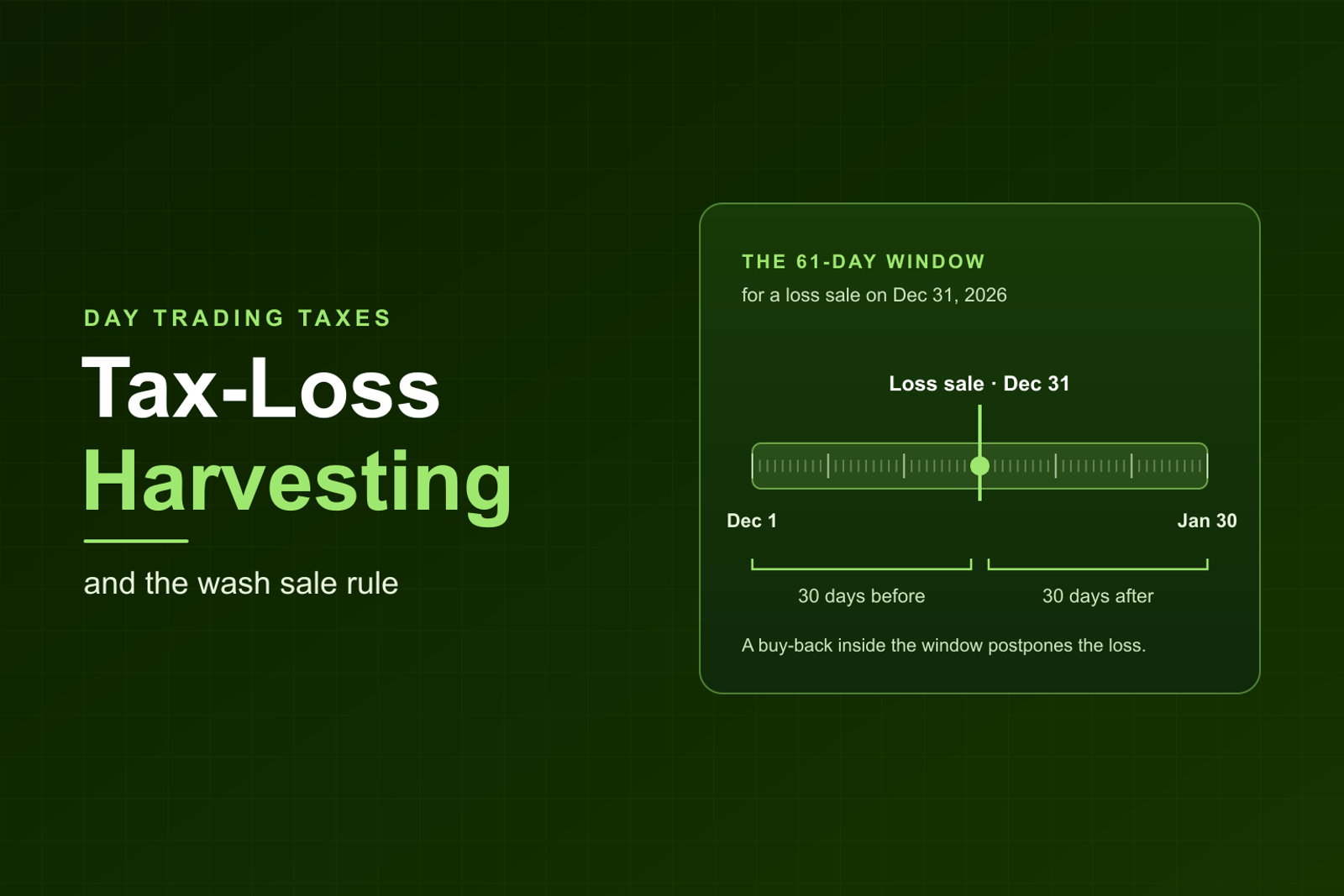
Short answer: Tax-loss harvesting means selling a position at a loss so the loss offsets realized gains, and up to $3,000 a year of other income ($1,500 if married filing separately). For a day trader who keeps trading the same tickers, the wash sale rule gets in the way: buy the same stock within 30 days before or after a loss sale, and the loss is postponed into the new shares. A sale with a trade date of Thursday, December 31, 2026 is reported on the 2026 return, even though it settles in January, and its wash sale window runs to January 30, 2027. This page is general education about US federal taxes in 2026. Your own situation needs a tax professional.
2026 key dates and limits
What tax-loss harvesting is
Tax-loss harvesting is a practitioner's term, and the tax code does not define it.
The IRS page Topic 409 says: "If you hold it one year or less, your capital gain or loss is short-term." Day trades fit that test, and net short-term gains are taxed as ordinary income.
IRS Publication 550 (Pub 550, 2025 edition), the IRS guide to investment income, nets short-term results together and long-term results together, then combines them on line 16 of Schedule D, the form where capital gains and losses are totaled. A net loss for the year offsets other income only up to "$3,000 ($1,500 if you are married and file a separate return)", and the unused part carries over "until it is completely used up".
The wash sale rule in plain words
Pub 550: "A wash sale occurs when you sell or trade stock or securities at a loss and within 30 days before or after the sale you" buy substantially identical stock, acquire "a contract or option to buy substantially identical stock or securities", or acquire it "for your individual retirement arrangement (IRA) or Roth IRA."
- The window. Thirty days before, the sale day and thirty days after make 61 days. The Treasury regulation (26 CFR 1.1091-1) calls it "the 61-day period".
- Substantially identical. Pub 550 says "you must consider all the facts and circumstances in your particular case." Stock of one company is ordinarily not substantially identical to another company's.
- Spouse and IRA. A purchase by your spouse counts. So does one in your IRA or Roth IRA, where the loss is not added to the cost of the IRA shares (Rev. Rul. 2008-5) and does not come back.
Outside the IRA case, the loss is postponed. Cost basis is what your shares cost for tax purposes, and gain or loss is measured from it. Pub 550 says to "add the disallowed loss to the cost of the new stock or securities", and "This adjustment postpones the loss deduction until the disposition of the new stock or securities." The holding period carries over too. The wash sale section of our taxes guide walks through the IRS's own worked example.
Why the wash sale rule is hard for day traders
Kev (Kevin Cabana, who runs the Momentum trading room) describes what trading is mostly like in his guide to momentum patterns: "Trading is mostly break-evens, small wins and small losses, and when a pattern fails I respect the stop and move to the next one."
Kev's rule for getting back into a stock after it rejected off the highs, from his 2026 strategy post: "The rule from there: price has to break back above, pull back, and retest to confirm before I touch it again." For any trader without a mark-to-market election, if the earlier exit was a sale at a loss, a second entry within 30 days is the purchase the wash sale rule looks at.
- The loss rolls forward. A washed loss sits in the basis of the replacement lot, which is the block of shares from one purchase. If that lot is sold at a loss and another purchase lands within 30 days, the larger loss is washed again. It keeps rolling until a lot is sold with no substantially identical purchase within 30 days before or after.
- Partial lots. If fewer shares are bought than were sold, only part of the loss is washed. Pub 550 matches shares "beginning with the first shares bought".
Hypothetical and simplified: one made-up small cap, XYZ, across the year end
Assumptions: a $20,000 account, long only, 1,000 shares per trade. Entry at $5.00 with the stop $0.20 lower risks $200, which is 1% of the account. That is the limit in the 1-2-3 rule taught in the Momentum room: "risk no more than 1% of your account on one trade". Each loss is matched to the next XYZ purchase after it. No XYZ trades happen in any other account, an IRA or a spouse's account. Fills are at the prices shown, and real stop fills can be worse.
On the 2026 return, each XYZ sale nets to $0 once the disallowed amount is added back with code W, the wash sale code on Form 8949, the form that lists each sale. XYZ adds $0 to the 2026 return while the account lost $300 in cash on XYZ in 2026. The two disallowed amounts total $500, but only $300 of cash loss is deferred, because the first $200 is counted again inside the second row.
Across 2026 and 2027, the cash result and the reported result are both minus $300, so the loss moved into 2027 and nothing was lost for good. Add one more made-up input: $5,000 of net short-term gains on other tickers in 2026. The 2026 return then shows $5,000 of net short-term gain, while the 2026 cash result across all tickers is $4,700.
Real matching can be more complex: the Dec 7 buy also sits inside the 30 days before the Dec 9 sale. Pub 550's matching order and the regulation decide how each lot is treated.
Clean vs washed: three ways the Dec 7 loss can play out
The year-end calendar for 2026
The trade date is the day a trade executes. The settlement date is the day delivery and payment are due. Pub 550 says a holding period "ends on the trade date you sold them" and adds: "Do not confuse the trade date with the settlement date."
In its example, dated 2025, a cash method, calendar year taxpayer sold stock on December 31, 2025 and was paid in January 2026, and Pub 550 says: "Report your gain or loss on your 2025 return, even though you received the payment in 2026."
Applied to the same taxpayer in 2026, a sale with a trade date of December 31, 2026 belongs on the 2026 return. Under T+1, trades "settle in one business day of their transaction date" (SEC Investor.gov). January 1, 2027 is a market holiday and January 2 and 3 are a weekend, so that trade settles Monday, January 4, 2027.
Some guides, including Vanguard's, say harvesting trades "must be executed and settled by the end of the calendar year." Pub 550 uses the trade date.
The window crosses the year. Section 1091(a) runs to "ending 30 days after such date" with no calendar-year limit.
- A January repurchase still counts. Buying the same stock on any day in January 2027 up to January 30 disallows a December 31 loss, or the part of it matched to the shares bought, and moves it into the January lot.
- A December purchase can count as well. A purchase of additional shares from December 1 to December 30, 2026 can also wash a December 31 loss, because the window runs 30 days before the sale too.
What the 1099-B shows and what it does not
Form 1099-B is the broker's statement of each sale, and a CUSIP number is the code that identifies a security. Box 1g on the form shows a wash sale loss the broker disallowed, and in general a covered security is stock bought for cash in an account after 2010. The Form 1099-B instructions tell brokers: "You must report any loss disallowed under section 1091 if both the sale and purchase transactions occur in the same account with respect to covered securities with the same CUSIP number."
Pub 550: "However, you cannot deduct a loss from a wash sale even if it is not reported on Form 1099-B."
1099-B reconciliation checklist
Is tax-loss harvesting worth it for a day trader?
A 2020 study of what harvesting is worth, published in the Financial Analysts Journal, looks at large stocks. Chaudhuri, Burnham and Lo simulated harvesting in "the 500 securities with the largest market capitalizations from 1926 to 2018", and the estimated benefit fell when they applied the wash sale rule. It does not measure small caps or positions held for minutes.
Vanguard's guide says harvesting "might not be worth it" for someone "in a lower tax bracket" or without "significant capital gains". For a trader who comes back to the same stock, the tables above show the trade-off: a loss counts in full in the year of the sale only if no substantially identical stock is bought in its window, and otherwise some or all of it is postponed, or lost when the purchase is in an IRA. A loss that counts is still subject to the $3,000 limit on losses against other income. How that plays out in a real account is a question for a tax professional.
Traders using the 475(f) mark-to-market method
Mark-to-market is an accounting method under section 475(f) of the tax code, and the IRS page Topic 429 says only traders can choose it. "The limitations on capital losses, the wash sale rules, and certain other rules do not apply to traders using the mark-to-market method of accounting (see section 475(d)(1))." Securities held for investment keep the investor rules.
Without the election, the wash sale rules keep applying even to someone who qualifies as a trader. Topic 429 sets three conditions, including "Your activity must be substantial", and gives no trade count.
The election is due by the original due date, without extensions, of the prior year's return. For 2026, that was April 15, 2026, which has passed. A new taxpayer with no return due for the prior year has a different date: 2 months and 15 days after the first day of the election year. Topic 429 says "in general, late section 475(f) elections aren't allowed."
The mark-to-market section of our taxes guide has more. Whether it fits anyone's situation is a question for a tax professional.
Keeping the 30-day window visible in your records
A trading journal that logs every entry and exit by date and ticker shows repeat entries in the same stock, and it can be checked against the 1099-B.
The same journal can hold one more column for tax records: for each sale at a loss, the date and the last day of the 30 days after it. A later purchase in the same stock can then be matched to that loss before the 1099-B arrives.
Frequently asked questions
Can day traders tax-loss harvest?
Yes. Without a section 475(f) mark-to-market election, they follow the same rules as any investor. A loss counts in full in the year of the sale only if no substantially identical stock is bought within 30 days before or after it, in any account, including an IRA, or by a spouse. It is still subject to the $3,000 limit on losses against other income. With a valid election, the wash sale rules do not apply to securities held in the trading business.
What is the last date to harvest tax losses in 2026?
Thursday, December 31, 2026 is the last trading day of the year. Pub 550 uses the trade date, so a sale that day is reported on the 2026 return. A loss on it counts for 2026 only if no substantially identical stock is bought in its wash sale window, December 1, 2026 to January 30, 2027, and it is still subject to the $3,000 limit on losses against other income.
Can I sell a stock and buy it back the same day?
If the sale was at a loss, buying the same stock back that day is a purchase within 30 days, so it is a wash sale for the shares bought back. The loss moves into the cost of the new shares until they are sold.
Does a wash sale loss disappear?
Usually it is postponed into the basis of the replacement shares and counts when those shares are sold, if that sale is not washed too. The exception is a replacement bought in an IRA or Roth IRA, where the loss does not come back.
Can you harvest more than $3,000 in losses?
Losses offset capital gains without that cap. A net loss above gains offsets other income only up to $3,000 a year ($1,500 if married filing separately), and the rest carries over to later years.
Watch a trading day with Kev
Kev streams every morning in the Momentum day trading room and calls out his entry and stop as he takes each trade. The 7-day free trial includes the live stream, the recordings and the Momentum Journal. Start your 7-day free trial. Free for 7 days, then $197 a month. Cancel anytime.
This page is general education about US federal taxes. It is not tax advice. Talk to a tax professional about your situation.
This content is for educational purposes only and is not financial advice. Trading involves significant risk and may not be suitable for all traders.